

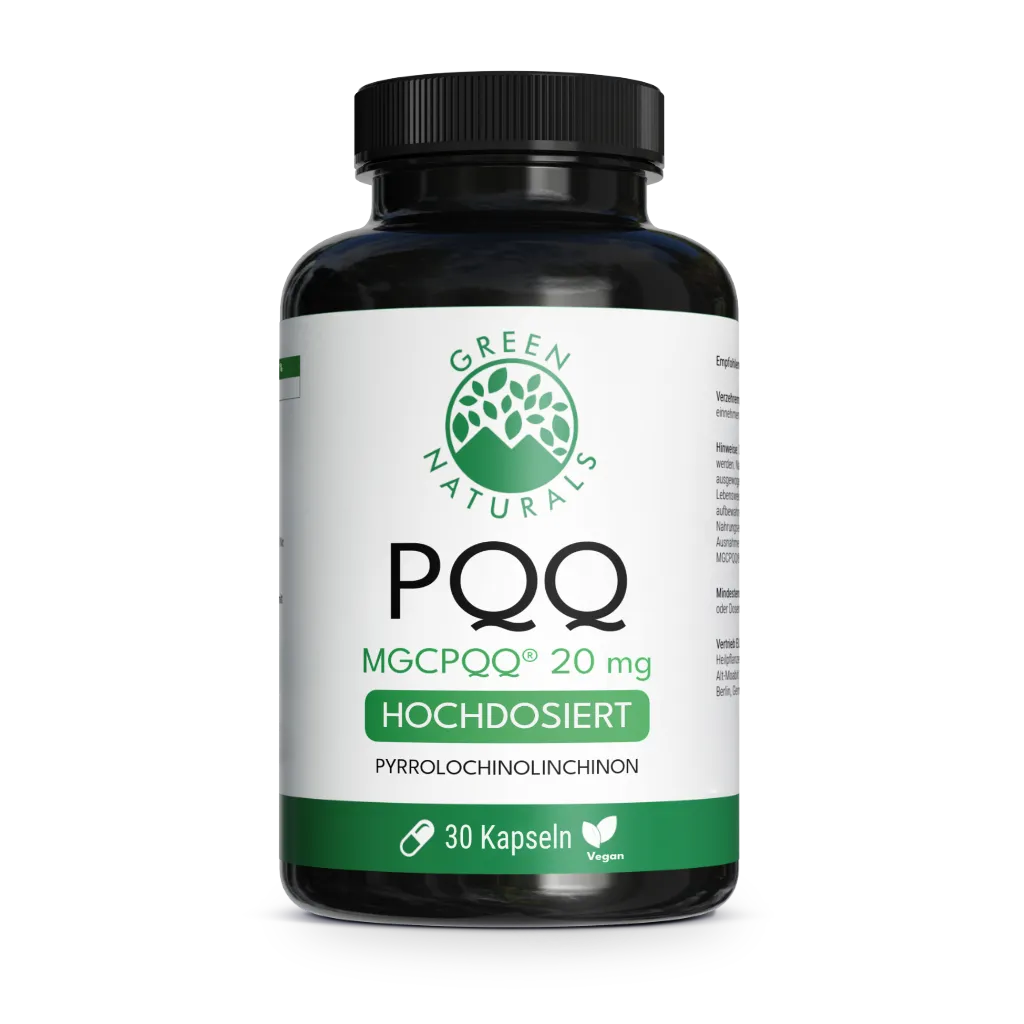
PQQ Capsules with MGCPQQ® - 20 mg Pyrroloquinoline Quinone | 30 Capsules
PQQ Capsules with MGCPQQ® - 20 mg Pyrroloquinoline Quinone | 30 Capsules
PQQ Capsules with MGCPQQ® - 20 mg pyrroloquinoline quinone per day, the Japanese branded ingredient in the amount used in human studies.
- 20 mg MGCPQQ® (pyrroloquinoline quinone disodium salt) per capsule = per daily dose
- Branded ingredient from Mitsubishi Gas Chemical (Japan) - obtained by fermentation, specified to a purity of at least 99%
- Study-based dosage: 20 mg per day corresponds to the amount used in human studies with MGCPQQ® and to the maximum level of the EU novel food authorisation
- Vegan & hypoallergenic - HPMC capsule, rice flour as the only carrier, no magnesium stearate, gluten-free, lactose-free
- Lab-tested premium quality - made in Austria, every batch independently tested
- 30 capsules = 30 days - 1 capsule daily, PZN 21029344

Want to save more?
Choose a bundle and save more!
Couldn't load pickup availability
30-day returns, SSL-secured checkout


PQQ (pyrroloquinoline quinone) - the redox cofactor
- PQQ (pyrroloquinoline quinone, also known as methoxatin) is a quinone compound with the molecular formula C14H6N2O8. It was identified in 1979 as a cofactor of bacterial enzymes and is sometimes referred to as "vitamin B14" - officially, however, PQQ is not a vitamin.
- PQQ is a redox-active molecule: it can repeatedly accept and donate electrons. Research therefore investigates PQQ primarily in connection with mitochondria and cellular redox processes.
- In nature, PQQ occurs in trace amounts in foods such as natto, parsley, green tea, kiwi, papaya and tofu - in the microgram range per 100 g. The 20 mg in one capsule is therefore well above the amount absorbed through a normal diet.
MGCPQQ® - a branded ingredient from Japan instead of anonymous powder
- Green Naturals PQQ capsules contain the branded ingredient MGCPQQ® from Mitsubishi Gas Chemical (Japan) at 20 mg per daily dose - in contrast to many manufacturers who use PQQ of unclear origin without proof of a branded ingredient.
- MGCPQQ® is obtained by fermentation with the bacterium Hyphomicrobium denitrificans and is specified to a purity of at least 99%. In 2017, EFSA assessed PQQ disodium salt as safe for healthy adults at up to 20 mg per day (EFSA NDA Panel, 2017).
- The ingredient is documented in human studies: a randomised, double-blind, placebo-controlled 12-week study investigated 20 mg PQQ disodium salt per day in adults aged 20 to 65 (Tamakoshi et al., 2023) - in contrast to suppliers with 10 mg or less per capsule, which remain below the amount used in studies.
PQQ effects - what EFSA says and what research is investigating
- There are currently no authorised health claims for PQQ according to EFSA. We therefore deliberately refrain from making efficacy promises and provide transparent information on the current state of research.
- PQQ is being investigated in connection with mitochondria, inflammatory markers and cognitive parameters, among other things - for example in a human study in which 10 participants took PQQ in two study phases (Harris et al., 2013).
- Compared with coenzyme Q10, which is itself part of the mitochondrial respiratory chain, PQQ is an independent redox cofactor - which is why the two substances are often considered together. At 1 capsule daily, 30 capsules last for 30 days.

-

Optimal time of intake
Take 1 capsule daily with sufficient liquid, ideally in the morning with breakfast. Above all, regular daily intake at the same time of day is important.
-

Dosage and duration of use
Daily dose: 1 capsule (= 20 mg pyrroloquinoline quinone disodium salt MGCPQQ®). We recommend continuous intake for at least 8 weeks; in human studies, PQQ was investigated over 12 weeks. The pack of 30 capsules lasts for 30 days. Do not exceed the recommended daily dose. For adults only, not suitable for pregnant or breastfeeding women.


| Quality criterion | Green Naturals® | Other manufacturers |
|---|---|---|
| Ingredient & origin | ✔ Branded ingredient MGCPQQ® from Mitsubishi Gas Chemical (Japan) | ✕ |
| Purity & production | ✔ obtained by fermentation, specified to min. 99% purity | ✕ |
| Clinical documentation | ✔ investigated in randomised, placebo-controlled human studies | ✕ |
| Sensible dosage | ✔ 20 mg per daily dose, study-based | ✕ |
| Regulatory safety | ✔ EU novel food authorisation, EFSA safety assessment up to 20 mg/day | ✕ |
| Purity & laboratory testing | ✔ made in Austria, every batch lab-tested | ✕ |
| Formulation & tolerability | ✔ vegan HPMC capsule, only rice flour as carrier | ✕ |
| Transparency & responsibility | ✔ clear notes on pregnancy & breastfeeding, no efficacy promises | ✕ |
| Practicality | ✔ 1 capsule daily, 30 capsules = 30 days | ✕ |
Our vision at Green Label® is to create products based on purity and transparency. Our approach is to source high-quality raw materials directly from leading producers worldwide to offer a product that is uncompromisingly committed to natural ingredients. Every capsule of our products carries the promise of purity, sustainability, and maximum effectiveness:
- Premium active ingredients as pure substances, directly from leading producers.
- Production and bottling under the highest pharmaceutical standards (GMP, ISO 22000:2018, HACCP).
- Maximum avoidance of all additives; only valuable natural substances are used.
- Vegan capsule shells, 100% free of PEG and other undesirable substances.
- Packaging in environmentally friendly, non-toxic materials for optimal aroma protection.

My name is Dr. Hari Sven Krishnan, founder of Heilpflanzenwohl GmbH and chief pharmacist.
Together with an experienced team of specialists, including Stephan Walz (pharmacist), Marie Schröder (nutritional scientist), and Dr. Christiane Gras (immunologist), we developed Green Naturals.
The result of intensive research with a clear goal: to offer you natural, highly effective products. At Heilpflanzenwohl, quality and purity come first, because we are convinced: "The best medicine comes from nature – we just need to learn how to use it correctly."
| Ingredients | 1 capsule / day | *NRV % |
|---|---|---|
| Pyrroloquinoline quinone disodium salt (MGCPQQ®) | 20 mg | ** |
** no reference available
What is PQQ?
What is PQQ good for?
What does PQQ do?
How does PQQ compare to Q10?
When should I take PQQ?
Which foods contain PQQ?
What is MGCPQQ®?
What is the dosage of the PQQ capsules?
Does PQQ have side effects?
Is PQQ a vitamin?
Can the capsules be opened?
Is the product completely natural?
Is PQQ suitable during pregnancy?
Are the PQQ capsules available in pharmacies?
Discover our top sellers
-
DAO (diamine oxidase)
High-dose herbal DAO (diamine oxidase) with 100,000 HDU per capsule from pea sprout powder. Our DAO capsules provide the body with the enzyme diamine oxidase, which supports histamine breakdown.
39,95 €79,90 €119,85 €75,92 €107,89 €37,95 €72,12 €102,49 €107,97 € 102,57 € 97,17 € 102,57 € 97,44 € 92,31 € per 100gRegular price 39,95 €Regular priceUnit price 107,97 € per 100g -
Shilajit ultra-high dose (2000 mg)
Ultra-high-dose premium 20:1 Shilajit extract (2,000 mg) with 1,000 mg fulvic acid and 240 mg humic acid per dose. Discover Shilajit, the "conqueror of mountains," as it has been praised for centuries in traditional Ayurveda, harvested from the heights of the Himalayas.
49,95 €99,90 €149,85 €94,92 €134,89 €47,45 €90,17 €128,14 €243,66 € 231,48 € 219,29 € 231,48 € 219,90 € 208,33 € per kgRegular price 49,95 €Regular priceUnit price 243,66 € per kg -
Spermidine Ultra Forte 6 mg
Ultra high-dose spermidine forte 6 mg per capsule. Our Spermidine forte is derived from high-quality wheat extract, which is carefully selected to ensure the purest and most effective form of spermidine.
59,95 €119,90 €179,85 €113,92 €161,89 €56,95 €108,22 €153,79 €124,90 € 118,66 € 112,41 € 118,66 € 112,72 € 106,79 € per 100gRegular price 59,95 €Regular priceUnit price 124,90 € per 100g -
Liposomal Magnesium
Bioavailable liposomal magnesium with 250 mg magnesium per daily dose. Green Naturals Liposomal Magnesium utilizes advanced liposomal technology to maximize the bioavailability of magnesium. This ensures that more magnesium can penetrate cell walls and be effectively utilized.
32,95 €65,90 €98,85 €62,62 €88,99 €31,30 €59,49 €84,54 €35,82 € 34,03 € 32,24 € 34,03 € 32,33 € 30,63 € per 100gRegular price 32,95 €Regular priceUnit price 35,82 € per 100g -
Glycine (2000 mg)
High-dose 2,000 mg premium glycine per daily serving (2 capsules). Glycine is an amino acid that plays an important role in the human body and is particularly utilized during active phases of life.
14,95 €29,90 €44,85 €28,42 €40,39 €14,20 €27,00 €38,37 €10,68 € 10,15 € 9,61 € 10,15 € 9,64 € 9,13 € per 100gRegular price 14,95 €Regular priceUnit price 10,68 € per 100g


Sources
- Tamakoshi, M., Suzuki, T., Nishihara, E., Nakamura, S. & Ikemoto, K. (2023). Pyrroloquinoline quinone disodium salt improves brain function in both younger and older adults. Food & Function, 14(5), 2496-2501. DOI: 10.1039/D2FO01515C
- Harris, C.B. et al. (2013). Dietary pyrroloquinoline quinone (PQQ) alters indicators of inflammation and mitochondrial-related metabolism in human subjects. Journal of Nutritional Biochemistry, 24(12), 2076-2084. DOI: 10.1016/j.jnutbio.2013.07.008
- EFSA NDA Panel (2017). Safety of pyrroloquinoline quinone disodium salt as a novel food pursuant to Regulation (EC) No 258/97. EFSA Journal, 15(11), 5058. DOI: 10.2903/j.efsa.2017.5058
Remarks
- HACCP (Hazard Analysis and Critical Control Points) is a preventive system for ensuring food safety that identifies and assesses potential hazards in production and minimizes them through targeted control measures. The seal refers to the manufacturing process.
- This is how the grade is calculated: Grade calculation based on star ratings: 5.00 - 4.50 Very good, 4.49 - 3.50 Good, 3.49 - 2.50 Satisfactory, 2.49 - 1.50 Sufficient, 1.49 - 1.00 Poor. For the verification of ratings, no authenticity check of customer reviews is carried out. The ratings are combined from different sources, such as mail-order pharmacies and online marketplaces. Last updated: 20.10.26