


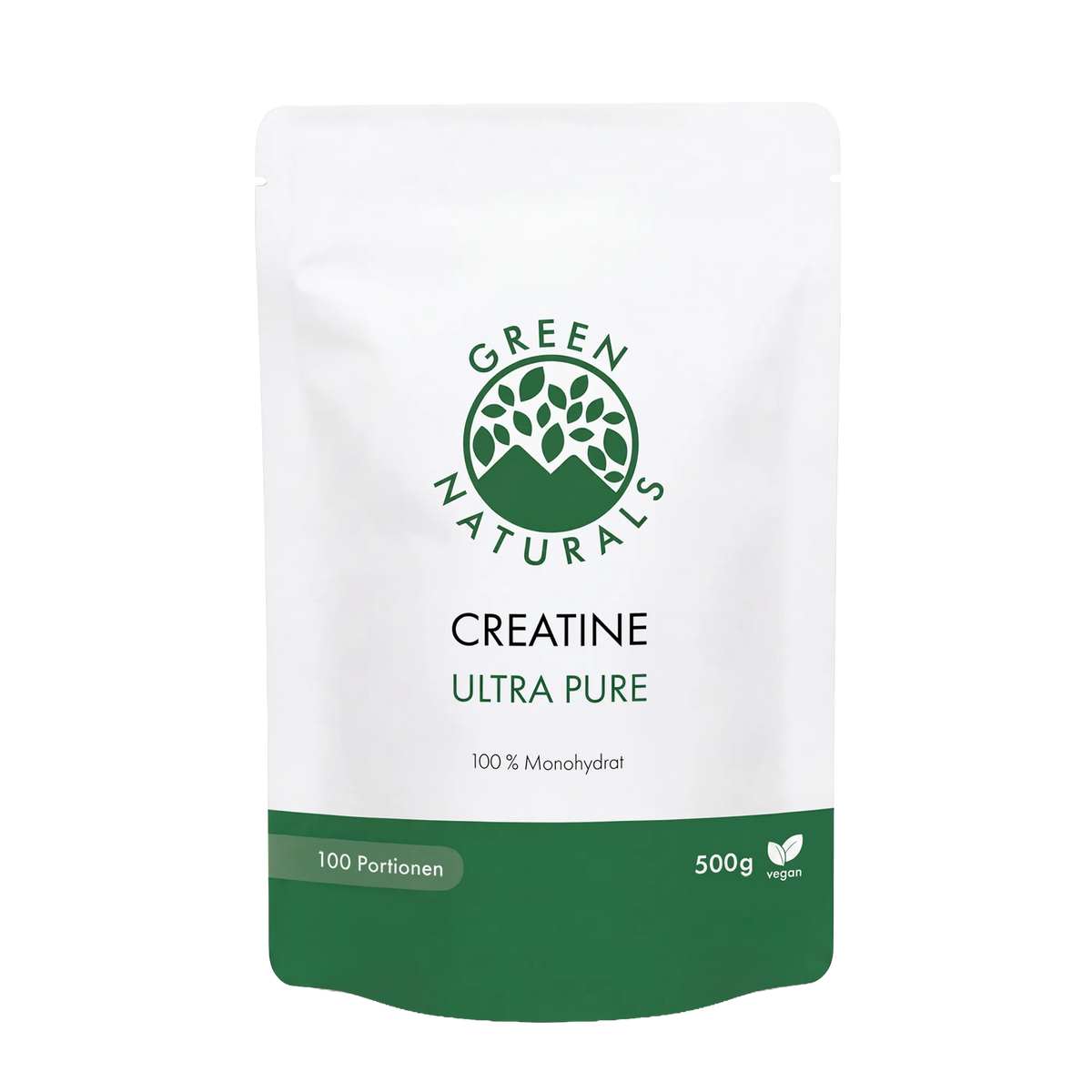
GREEN NATURALS® Creatine Ultra Pure Powder - 4.4 g creatine per daily dose
GREEN NATURALS® Creatine Ultra Pure Powder - 4.4 g creatine per daily dose
Green Naturals® Creatine Ultra Pure - 4.4 g pure creatine per daily dose from 100 % creatine monohydrate powder, with no additives.
- 4.4 g creatine per daily dose - from 5 g creatine monohydrate (1 scoop), dissolved in 400 ml of water
- Performance in high intensity exercise: Creatine increases physical performance in successive bursts of short-term, high intensity exercise (from 3 g daily)
- Research-based dosage: 3-5 g creatine monohydrate per day matches the maintenance dose used in scientific studies - no loading phase needed
- 100 % monohydrate - the most thoroughly researched form of creatine, free from carriers, flavourings, sweeteners or anti-caking agents, vegan, gluten-free, lactose-free
- Lab-tested premium quality - filled in Austria, every batch independently tested
- 500 g = 100 daily servings - more than 3 months' supply, PZN 20996467

Want to save more?
Choose a bundle and save more!
Couldn't load pickup availability
30-day returns, SSL-secured checkout


Creatine - the energy carrier of your muscles
- Creatine (chemically methylguanidinoacetic acid) is a nitrogen-containing organic acid produced naturally in the body. Every day, the liver, kidneys and pancreas synthesise around 1-2 g of it from the amino acids arginine, glycine and methionine.
- Around 95 % of the body's creatine is stored in skeletal muscle - much of it as phosphocreatine (creatine phosphate), which enables the rapid regeneration of ATP (adenosine triphosphate) during short-term, intense exertion. The remaining 5 % or so is distributed across tissues with a high energy turnover, above all the brain, which has its own creatine-phosphocreatine system.
- Creatine was discovered in 1832 by the French chemist Michel Eugène Chevreul in meat extract - the name derives from the Greek "kreas" (meat). In the diet, creatine comes mainly from meat and fish (around 0.5 g per 100 g); a vegetarian or vegan diet contains practically no creatine at all.
100 % creatine monohydrate powder - the most thoroughly researched form of creatine
- Green Naturals Creatine Ultra Pure contains nothing but pure creatine monohydrate - 4.4 g creatine per daily dose from 5 g monohydrate - unlike many manufacturers who offer creatine blends, flavoured mixes or capsules with carriers and a lower amount of creatine per serving.
- Creatine monohydrate is regarded as the best-documented form of creatine: in its position stand, the International Society of Sports Nutrition (ISSN) describes it as the most effectively studied form, whose uptake into muscle and maintenance dose of 3-5 g per day have been examined in numerous studies (Kreider et al., 2017).
- Newer forms of creatine such as creatine ethyl ester, buffered creatine or creatine HCl were compared with monohydrate in a review with regard to efficacy, safety and regulatory status - no superiority of these forms could be demonstrated (Jäger et al., 2011). That is why Green Naturals deliberately relies on classic monohydrate - unlike many suppliers who market special forms with a weaker evidence base at higher prices.
More performance in high intensity exercise - with 4.4 g creatine per day
- Creatine increases physical performance in successive bursts of short-term, high intensity exercise (authorised health claim under EU Regulation 432/2012). The beneficial effect is obtained with a daily intake of 3 g creatine - Green Naturals provides more than this amount with 4.4 g creatine (from 5 g creatine monohydrate) per daily dose.
- For adults over the age of 55, a further claim applies: Daily creatine consumption can enhance the effect of resistance training on muscle strength in adults over the age of 55 - with 3 g creatine daily in combination with regular resistance training (at least three times a week over several weeks).
- 500 g of pure powder lasts 100 days at 5 g per day - a convenient supply for more than 3 months, with a measuring scoop for precise dosing.

-

Best time to take it
Dissolve 1 scoop (5 g) in around 400 ml of water and drink the mixture straight away. Whether before or after training, or with a meal on rest days - timing is secondary. What matters is consistent daily intake, so that the creatine stores in your muscles fill up and stay full.
-

Dosage and duration of use
Daily dose: 4.4 g creatine from 5 g creatine monohydrate (1 scoop). No loading phase is required - with a daily intake of 3-5 g, muscle stores are saturated after around 3-4 weeks. We recommend continuous use for at least 8 weeks; the 500 g tub lasts 100 days. Make sure you drink enough fluids. For adults only. Pregnant and breastfeeding women and children should seek medical or pharmaceutical advice before use.


| Quality criterion | Green Naturals® | Other manufacturers |
|---|---|---|
| Raw material & purity | ✔ 100 % creatine monohydrate, free from flavourings, sweeteners, carriers or anti-caking agents | ✕ |
| Scientific documentation | ✔ Monohydrate - the most thoroughly researched form of creatine (ISSN position stand) | ✕ |
| Sensible dosage | ✔ 4.4 g creatine per daily dose (from 5 g monohydrate), research-based and without a loading phase | ✕ |
| Proven benefit (EFSA) | ✔ increases physical performance in successive bursts of short-term, high intensity exercise (official EFSA wording) | ✕ |
| Laboratory testing | ✔ every batch independently tested, filled in Austria | ✕ |
| Formulation & tolerability | ✔ vegan, gluten-free, lactose-free, dissolves well in 400 ml of water | ✕ |
| Transparency & responsibility | ✔ creatine content (4.4 g) declared, clear guidance for pregnant and breastfeeding women and children | ✕ |
| Practicality | ✔ 1 scoop a day, 500 g = 100 days | ✕ |
Our vision at Green Label® is to create products based on purity and transparency. Our approach is to source high-quality raw materials directly from leading producers worldwide to offer a product that is uncompromisingly committed to natural ingredients. Every capsule of our products carries the promise of purity, sustainability, and maximum effectiveness:
- Premium active ingredients as pure substances, directly from leading producers.
- Production and bottling under the highest pharmaceutical standards (GMP, ISO 22000:2018, HACCP).
- Maximum avoidance of all additives; only valuable natural substances are used.
- Vegan capsule shells, 100% free of PEG and other undesirable substances.
- Packaging in environmentally friendly, non-toxic materials for optimal aroma protection.

My name is Dr. Hari Sven Krishnan, founder of Heilpflanzenwohl GmbH and chief pharmacist.
Together with an experienced team of specialists, including Stephan Walz (pharmacist), Marie Schröder (nutritional scientist), and Dr. Christiane Gras (immunologist), we developed Green Naturals.
The result of intensive research with a clear goal: to offer you natural, highly effective products. At Heilpflanzenwohl, quality and purity come first, because we are convinced: "The best medicine comes from nature – we just need to learn how to use it correctly."
| Zusammensetzung | pro Tagesdosis = 5 g | *NRV% |
|---|---|---|
| Kreatinmonohydrat | 5 g | ** |
| • davon Kreatin | 4,4 g | ** |
** no reference available
What is creatine?
What is creatine good for?
What does creatine do in the body?
What role does creatine play in the brain?
How much creatine per day?
When should you take creatine - before or after a workout?
Do you need a loading phase?
Which creatine is best?
How quickly does creatine work?
Is creatine vegan?
Which foods contain creatine?
What is the dosage of Green Naturals Creatine Ultra Pure?
Does creatine expire?
Is the product completely natural?
Is the product suitable for pregnant or breastfeeding women and children?
Where can I buy Green Naturals creatine?
Discover our top sellers
-
DAO (diamine oxidase)
High-dose herbal DAO (diamine oxidase) with 100,000 HDU per capsule from pea sprout powder. Our DAO capsules provide the body with the enzyme diamine oxidase, which supports histamine breakdown.
39,95 €79,90 €119,85 €75,92 €107,89 €37,95 €72,12 €102,49 €107,97 € 102,57 € 97,17 € 102,57 € 97,44 € 92,31 € per 100gRegular price 39,95 €Regular priceUnit price 107,97 € per 100g -
Shilajit ultra-high dose (2000 mg)
Ultra-high-dose premium 20:1 Shilajit extract (2,000 mg) with 1,000 mg fulvic acid and 240 mg humic acid per dose. Discover Shilajit, the "conqueror of mountains," as it has been praised for centuries in traditional Ayurveda, harvested from the heights of the Himalayas.
49,95 €99,90 €149,85 €94,92 €134,89 €47,45 €90,17 €128,14 €243,66 € 231,48 € 219,29 € 231,48 € 219,90 € 208,33 € per kgRegular price 49,95 €Regular priceUnit price 243,66 € per kg -
Spermidine Ultra Forte 6 mg
Ultra high-dose spermidine forte 6 mg per capsule. Our Spermidine forte is derived from high-quality wheat extract, which is carefully selected to ensure the purest and most effective form of spermidine.
59,95 €119,90 €179,85 €113,92 €161,89 €56,95 €108,22 €153,79 €124,90 € 118,66 € 112,41 € 118,66 € 112,72 € 106,79 € per 100gRegular price 59,95 €Regular priceUnit price 124,90 € per 100g -
Liposomal Magnesium
Bioavailable liposomal magnesium with 250 mg magnesium per daily dose. Green Naturals Liposomal Magnesium utilizes advanced liposomal technology to maximize the bioavailability of magnesium. This ensures that more magnesium can penetrate cell walls and be effectively utilized.
32,95 €65,90 €98,85 €62,62 €88,99 €31,30 €59,49 €84,54 €35,82 € 34,03 € 32,24 € 34,03 € 32,33 € 30,63 € per 100gRegular price 32,95 €Regular priceUnit price 35,82 € per 100g -
Glycine (2000 mg)
High-dose 2,000 mg premium glycine per daily serving (2 capsules). Glycine is an amino acid that plays an important role in the human body and is particularly utilized during active phases of life.
14,95 €29,90 €44,85 €28,42 €40,39 €14,20 €27,00 €38,37 €10,68 € 10,15 € 9,61 € 10,15 € 9,64 € 9,13 € per 100gRegular price 14,95 €Regular priceUnit price 10,68 € per 100g


Sources
- Kreider, R.B. et al. (2017). International Society of Sports Nutrition position stand: safety and efficacy of creatine supplementation in exercise, sport, and medicine. Journal of the International Society of Sports Nutrition, 14, 18. DOI: 10.1186/s12970-017-0173-z
- Jäger, R. et al. (2011). Analysis of the efficacy, safety, and regulatory status of novel forms of creatine. Amino Acids, 40(5), 1369-1383. DOI: 10.1007/s00726-011-0874-6
- Antonio, J. et al. (2021). Common questions and misconceptions about creatine supplementation: what does the scientific evidence really show? Journal of the International Society of Sports Nutrition, 18, 13. DOI: 10.1186/s12970-021-00412-w
- Commission Regulation (EU) No 432/2012, Annex: List of permitted health claims - Creatine. Supplemented by Commission Regulation (EU) 2017/672.
Remarks
- HACCP (Hazard Analysis and Critical Control Points) is a preventive system for ensuring food safety that identifies and assesses potential hazards in production and minimizes them through targeted control measures. The seal refers to the manufacturing process.
- This is how the grade is calculated: Grade calculation based on star ratings: 5.00 - 4.50 Very good, 4.49 - 3.50 Good, 3.49 - 2.50 Satisfactory, 2.49 - 1.50 Sufficient, 1.49 - 1.00 Poor. For the verification of ratings, no authenticity check of customer reviews is carried out. The ratings are combined from different sources, such as mail-order pharmacies and online marketplaces. Last updated: 13.10.26

